Scenario Intelligence in Action: How ROSL Drives AD R&D Iteration
2026-11-17
As autonomous driving moves toward large-scale commercialization, one question keeps coming back: how do you keep algorithms safe and robust in a world of infinite complexity? At Inceptio, we have been working on this question in practice, and our answer is this: deep mining and disciplined use of real-world operational data is the key to efficient commercial validation. Based on more than 1 billion kilometers of commercial operation and massive daily data from our operating fleet, we are formally introducing ROSL (Real-world Operation Scenario Library). It is not just a dataset — it is a methodology built on "real-world scenario distribution as the driver." It provides a systematic, quantifiable data asset, and it gives AD R&D and testing a continuous optimization path and a scientific basis for decisions.
1. Real-world Operation: From Random Sampling to Full-Scenario Insight
The core logic of ROSL is to break away from the limits of traditional "targeted collection" and build a digital mirror of the real world through random scenario sampling plus cloud-based scenario parsing.
One challenge we constantly run into in AD development is that real-world driving scenarios are endlessly varied, while the data we can deliberately collect is often quite limited. How to cover as many representative real-world scenarios as possible at low collection cost, and understand how often those scenarios actually occur in the real world — this determines whether we can maximize the value of data and use it as a lever to drive the flywheel of product optimization.
This is where ROSL's random scenario collection system comes in. Leveraging Inceptio's vehicle-cloud data pipeline, we deploy on-vehicle recording capability that samples scenario clips uniformly. During operation, the AD system triggers a 20-second scenario clip recording at a certain probability (e.g., 1%) and automatically uploads it to the cloud. Random sampling is inherently "unbiased" — it ensures the collected data reflects the real scenario distribution proportionally, making it a miniature of the real world.
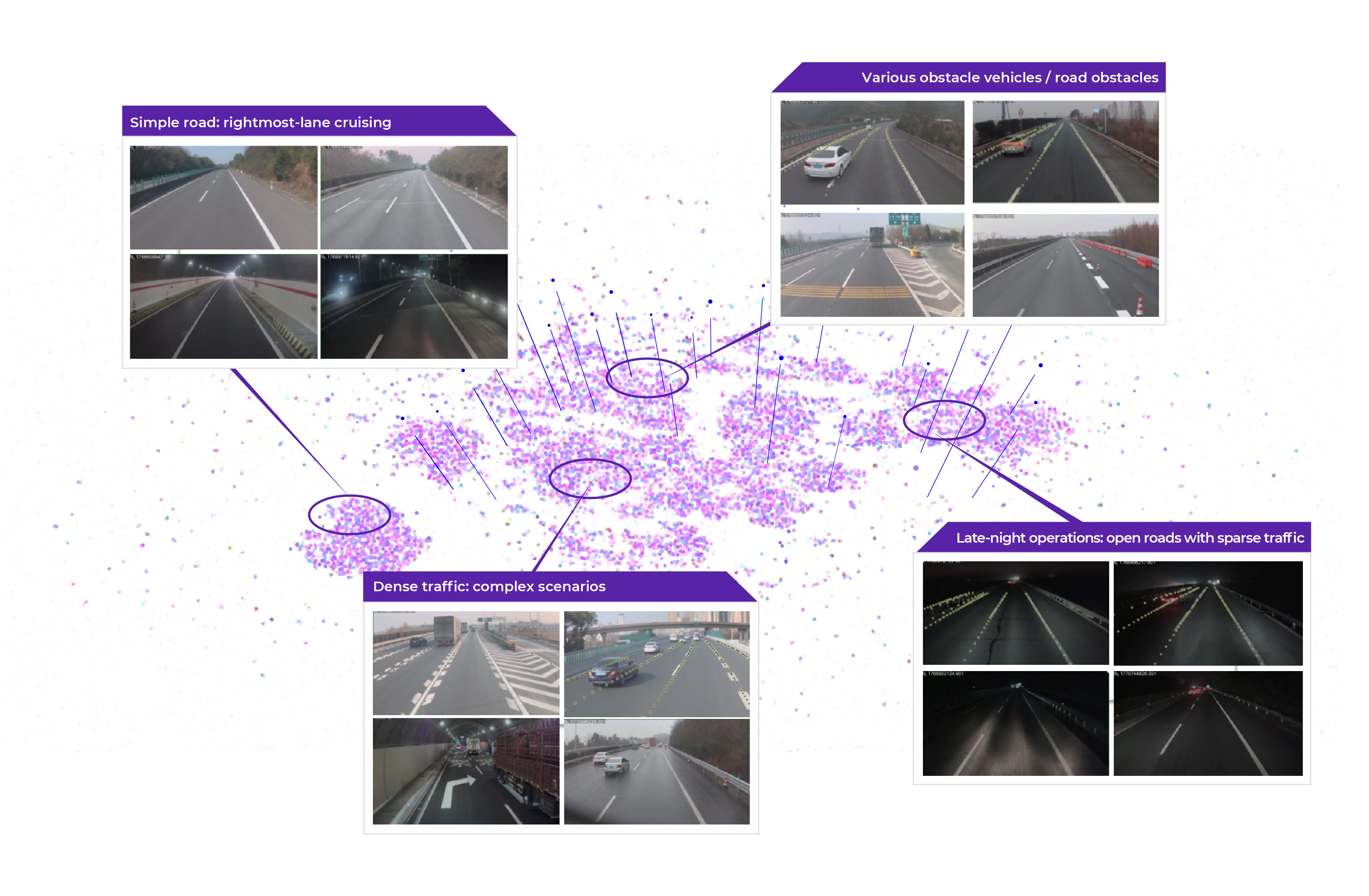
Through ROSL, we can collect a wide range of scenarios from freight environments;
by aggregating similar scenarios, we can understand how frequently different scenario types occur in real operations.
Combined with Inceptio's extensive highway transport network, as operational mileage keeps growing, both high-frequency routine conditions and extremely low-frequency long-tail scenarios (such as a third-party accident or extreme weather occurring once in ten thousand kilometers) are naturally captured by ROSL during operation. Understanding random scenario data well lets us efficiently understand the endlessly changing real world and validate AD system functions in an environment as close to reality as possible.
2. Scenario Library: Automated Scenario Parsing, Building a Scenario Archive
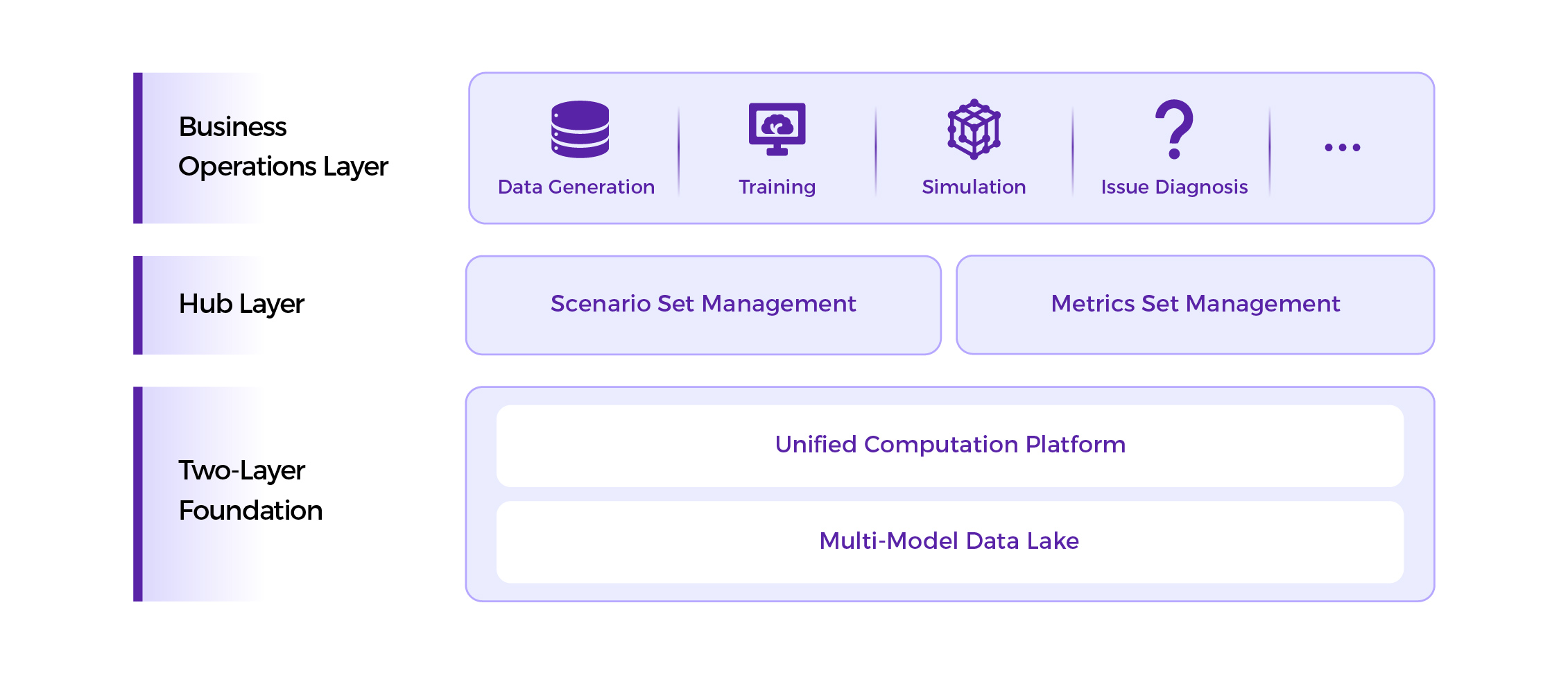
A high-quality scenario dataset is only the first step. To actually use this data well — to fully extract scenario information and reason about the real world — you need a powerful cloud data system as the foundation. To this end, Inceptio built a next-generation data operating system, "Data OS," which addresses the challenges of the data loop through a layered architecture, providing unified resource scheduling and unified standard protocols to reduce overall complexity.
Inceptio Data OS
Inceptio's Data OS consists of the following layers, from bottom to top:
• Foundation layer (storage and compute): solves "can we store it, can we compute it fast enough," tackling scale and compute challenges. Through a multimodal data lake and a high-performance unified compute platform, it supports data cleaning, intelligent understanding, and scenario label recognition for massive scenario clips.
• Hub layer (scenario sets and metric sets): solves "can we find it accurately, can we control it," coordinating collaboration and evolution pressure through a unified language. At this layer, we combine AI semantic understanding and engineering optimization to build scenario-information extraction operators at scale — for example, using VLM (vision-language models) to batch-identify all obstacles and their types, lane lines, road topology, weather conditions such as clear, rain, snow, and fog, and whether pedestrians or construction scenes are present in each data clip. By extracting semantic information from the data, we tag each clip with rich scenario labels.
• Business operations layer (application scenarios): solves "is it stable enough, is it efficient enough," achieving full-pipeline automation to handle robustness and efficiency pressure. Full-pipeline automation reduces manual operations, allowing scenario label profiles to flow efficiently and automatically into downstream R&D, simulation, and issue investigation, continuously driving AD system optimization.
This entire service runs automatically every day, supporting real-time processing of tens of thousands of new clips, converting unstructured video streams into structured combinations of scenario labels and issuing a "scenario ID card" for every data clip. Refined and semantically extracted by Data OS, the random scenario data collected through ROSL becomes Inceptio's Scenario Library — a library of real-world scenarios — laying the foundation for subsequent deep analysis and data utilization.
3. From ROSL to R&D and Testing: A Technology-Driven Efficiency Revolution
ROSL does more than solve the question of "do we have data." Through its accompanying advanced scenario feature extraction capabilities, it brings a qualitative leap to R&D and testing, addressing a series of pain points in algorithm development and validation. For example:
Evidence-driven scenario probability estimation
Traditional testing often relies on empirical assumptions, whereas ROSL, based on random sampling sets, can quickly and reliably answer how often various scenarios actually occur in the real world (such as the frequency of "rainy-day construction" or "mountain-road motorcycle groups"). Furthermore, using statistical methods such as Bootstrap, we can construct confidence intervals for frequency estimates, giving us a more scientific understanding of how accurate our estimates are. This statistical quantification capability lets us reason about how common various scenarios are in the real world, making R&D resource allocation more precise.

Scenario blind-spot identification and coverage quantification
ROSL can calculate how well the current test scenario set covers the real world and quickly identify "scenario blind spots." By comparing the cardinality and distribution of unique scenarios between the random scenario set and the existing test set, we can clearly identify which key scenarios still lack data among the collected clips (such as specific types of unusual trailers or extreme weather combinations). This quickly reveals which important real-world scenarios are missing from the AD test scenario set, guiding targeted data supplementation.
High-fidelity evaluation set construction and World Model development
Using the rich scenario combination distributions in ROSL — for example, what proportion of real scenarios passing under a gantry are daytime, nighttime, rainy, or overcast — we can build evaluation sets that match the real distribution, making evaluation metrics closer to how AD actually performs in real operations. In addition, the full-scenario real data in ROSL can serve as fine-tuning material or evaluation targets for World Models and Gen AI, improving the scenario reconstruction capability of generative AI, addressing the challenge of scarce long-tail data, and meeting the needs of rapid iteration in feature development, validation, and testing.

Various high-reflectivity sign scenarios in the real world
Scientifically optimizing the scenario label tree
During ROSL construction, we extract scenario labels through semantic understanding and build a scenario ID card for each clip. With sufficient ROSL data, the data can in turn drive upgrades and pruning of the scenario label tree. Based on AI vision-language models and the Data OS infrastructure, we can perform high-throughput, open-ended, 360-degree semantic recognition on each clip — potentially uncovering new label elements not yet covered by the current R&D scenario label tree, or discovering that some labels occur very sparsely in the real world. This allows us to continuously and dynamically adjust the scenario labeling system and refine the language used to describe scenarios.
The establishment of ROSL marks our shift from "passively collecting data" to "actively understanding the world." Through the combination of random sampling and deep parsing, ROSL not only fills blind spots in test scenarios but also provides a solid "scenario ground truth" for autonomous driving algorithm iteration through quantified coverage metrics. In the future, as the random scenario set continues to expand, ROSL will remain the core engine driving the safe deployment of Inceptio's autonomous driving technology.
For Inceptio, autonomous driving is not just an algorithm — it is "Physical AI" operating in the real physical world of freight. It needs to understand the interactions among truck dynamics, cargo load, highway roads, traffic participants, and complex operating conditions, internalizing the countless scenarios that can occur in the real world into the core of the algorithm. ROSL is precisely the data foundation and base of this "Freight Physical AI": it uses massive real-world operational scenarios as nutrients, letting the AD system repeatedly rehearse real freight scenarios in the digital world, so that every driving decision in the physical world is safer and more robust. From data to scenarios, from scenarios to intelligence, ROSL lets Inceptio's Freight Physical AI truly take root in the real world.