Freight-Native End-to-End Autonomous Driving for Logistics
2026-11-17
01 | Introduction
Autonomous driving is undergoing an architectural transition from modular intelligence to unified intelligence. With the advancement of end-to-end models and large language models, an increasing range of driving capabilities is being unified within data-driven models. This transition is already underway in passenger vehicles, but its significance for commercial vehicles goes far beyond an architectural change.
We believe that autonomous driving for commercial vehicles should not be a simple transfer of passenger-car autonomous-driving capabilities, nor should it merely involve porting general-purpose end-to-end models to trucks. Instead, it should evolve toward a truly logistics-oriented, Freight-Native End-to-End Autonomous Driving Model.
Commercial vehicles have more complex vehicle dynamics, higher safety requirements, and are deeply embedded in logistics operations. Autonomous driving for commercial vehicles must answer not only “How should I drive on the current road?” but also “What kind of vehicle am I driving?”, “What logistics mission am I executing?”, and “How can I complete the entire transportation process efficiently while maintaining safety?”
This article presents Inceptio’s perspective on the evolution of autonomous-driving technology for commercial vehicles, explains how to build a Freight-Native E2E Model, and explores how end-to-end intelligence can meet the safety requirements of autonomous commercial-vehicle operations.
02 | Commercial Vehicles Face Not Just Roads, but the Full Spectrum of Logistics Scenarios
Commercial vehicles operate across a wide range of distinct scenarios.
In long-haul transportation, vehicles operate for extended periods on highways and expressways, continuously encountering challenging conditions such as nighttime driving, heavy rain, dense fog, standing water, backlighting, road construction, and frequent interactions with large vehicles. When a fully loaded heavy-duty truck is traveling at highway speeds, a decision delayed by just a few seconds can significantly reduce the available safety margin. Compared with passenger cars in highway scenarios, the fundamental difference for commercial vehicles is not simply “seeing farther,” but also “being able to stop after seeing a hazard.” The braking distance of a fully loaded heavy-duty truck can be several times longer than that of a passenger car.
In urban delivery scenarios, autonomous vehicles must navigate complex interactions at intersections, mixed traffic involving motor vehicles and non-motorized road users, roadside parking, and high-density traffic flows. While passenger cars typically prioritize comfort and human-like driving behavior, urban commercial delivery places greater emphasis on traffic efficiency, alongside safety.
Once vehicles enter logistics parks, the driving environment rapidly shifts to low-speed, close-range, highly interactive operations. During peak operating periods, hundreds of vehicles compete to complete their tasks on time. Multi-vehicle encounters, right-of-way negotiations, parked vehicles blocking access, pedestrians and forklifts moving freely, and U-turns in confined spaces present significant challenges for commercial vehicles ranging from 6 to 20 meters in length. Passenger cars rarely need to handle such complex and unstructured traffic environments.
Therefore, the core challenge of autonomous driving for commercial vehicles is not simply solving an individual highway or logistics-park scenario. It is establishing unified, reliable, and continuously evolving driving intelligence that can operate across different logistics scenarios, vehicle states, and transportation missions.
03 | From Rule-Based Systems to Freight-Native E2E Models
Similar to the evolution of passenger-car autonomous driving, commercial-vehicle autonomous driving is progressing from rule-based systems and modular architectures toward end-to-end approaches.
Rule-based systems offer strong interpretability but struggle with the explosion of rules required as the Operational Design Domain (ODD) expands. Modular architectures improve environmental understanding and trajectory planning, but manually defined module interfaces still introduce information loss. Single-stage end-to-end models learn the mapping from environment to behavior directly, reducing information loss and improving human-like driving capabilities.
However, this is still insufficient for commercial vehicles. Even on the same road, different vehicle states, payloads, and logistics missions can correspond to different optimal driving strategies.
We believe that an end-to-end model for freight transportation can be expressed as:
Policy = f(Vehicle, Operational Context)
Here, Vehicle-aware addresses the question, “What can this vehicle safely do?” Operational Context encompasses two components: Mission and Environment. Mission-aware addresses the question, “What exactly does the current transportation task require?” Environment-aware addresses the question, “What is happening now, and what might happen next?”
Ultimately, a unified end-to-end policy answers one fundamental question:
Given the current traffic environment, this particular vehicle, and this specific logistics mission, how should the vehicle drive going forward?
Environment, Vehicle, and Mission together form a unified end-to-end architecture for commercial vehicles, enabling joint modeling from multimodal inputs to the final driving policy and paving the way for a truly freight-native solution.
04 | Freight-Native E2E Models: Understanding Vehicle, Environment, and Mission
Vehicle-aware: Enabling the Model to Understand “What It Is”
For commercial vehicles, driving strategies cannot be separated from the characteristics of the vehicle itself.
At the same speed of 80 km/h, an unloaded light-duty truck and a fully loaded tractor-trailer can differ significantly in braking distance, lateral response, turning radius, and vehicle stability. Even when the external road environment is identical, the two vehicles do not share the same set of safely executable actions.
Therefore, a Freight-Native E2E Model needs to encode information such as vehicle type, gross vehicle mass, payload state, vehicle dimensions, braking capability, powertrain state, and trailer posture into a unified Vehicle Representation.
This enables the model to learn not merely the behavior of an abstract “general-purpose driver,” but that of a professional driver who understands freight transportation.
The essence of Vehicle-aware intelligence is therefore to ensure that, before deciding “what should I do?”, the model first understands “what can I safely do?”
Environment-aware: From Understanding the Current Environment to Predicting Future Interactions
Scene understanding must also be redesigned to address the specific characteristics of commercial vehicles. We propose a Unified Freight Latent World Representation that adaptively integrates three levels of information—semantics, geometry, and intent—according to spatial range and risk characteristics.
In long-range scenarios, understanding road topology, merging and diverging traffic flows, the distribution of large vehicles, and the potential behavioral tendencies of other road users is particularly important. This enables commercial vehicles to determine early whether to change lanes, slow down, maneuver around obstacles, or queue, avoiding aggressive, last-minute maneuvers commonly associated with passenger-car driving. Accordingly, the model places greater emphasis on semantic and interaction information at longer distances.
As objects approach the ego vehicle, geometric information becomes increasingly important. The model must understand not only that “there is a vehicle ahead,” but also its precise relative position, physical contours, road boundaries, available drivable space, driving behavior, and potential intentions. Consequently, the model must pay particular attention to high-precision 3D geometric information in the near field.
Meanwhile, dynamic agents around the ego vehicle interact through cross-attention with road topology, other traffic participants, and the near-field 3D environment. This allows the model to infer the potential intentions of different traffic participants and predict their future multimodal motion distributions, enabling more precise risk assessment.
These information sources are ultimately consolidated into an Interaction-aware Latent Graph.Rather than merely describing “what the world looks like now,” the model develops an internal representation of “how the world may evolve in the future,” providing a more comprehensive Latent World Representation for subsequent planning.
For commercial vehicles, this means that safe driving can evolve beyond “responding promptly after a risk emerges” toward “understanding how a risk may develop and planning ahead before it materializes.”
Mission-aware: From Navigation-Based Driving to Mission-Oriented Driving
Commercial vehicles typically rely on navigation to tell drivers where to go, while waybill information and driving experience remain largely in the driver’s head. Based on their experience, drivers decide where to drive faster, where to rest, and how to reach the destination within the required time while minimizing energy consumption.
Passenger-car navigation strategies typically influence “which route to take” more than “how to drive.” In commercial transportation, however, the mission itself imposes distinct requirements on delivery timeliness, energy consumption, and driving smoothness, directly affecting the optimal driving behavior.
For example, consider two trucks traveling on the same road, with identical vehicle types and exactly the same navigation route, but different transportation deadlines. A truck with a flexible delivery schedule can favor economical driving by maintaining smooth cruising, reducing overtaking and lane changes, and lowering energy consumption. A truck facing a tight deadline may adopt a more assertive overtaking and lane-changing strategy when encountering slower vehicles.
In logistics operations, different transportation missions—including express delivery, cold-chain logistics, liquid cargo, and hazardous-material transportation—can demand substantially different driving strategies. The model must therefore explicitly encode the characteristics of each transportation mission.
In short, even when the environment, vehicle, and navigation route are exactly the same, different transportation missions still require adaptive driving strategies.
We therefore propose explicitly incorporating Mission as an input to the end-to-end model. Its key role is not to make time-sensitive missions drive more aggressively, but to influence the selection of optimal strategies within the safe operating envelope. Mission awareness enables autonomous commercial vehicles to balance time, energy consumption, driving smoothness, and transportation efficiency according to different operational priorities, all within established safety boundaries.
Over longer time horizons, Mission progressively influences driving strategies, enabling the system to evolve into a truly logistics-oriented Freight-Native E2E Model.
05 | Unified Architecture of the Freight-Native E2E Model
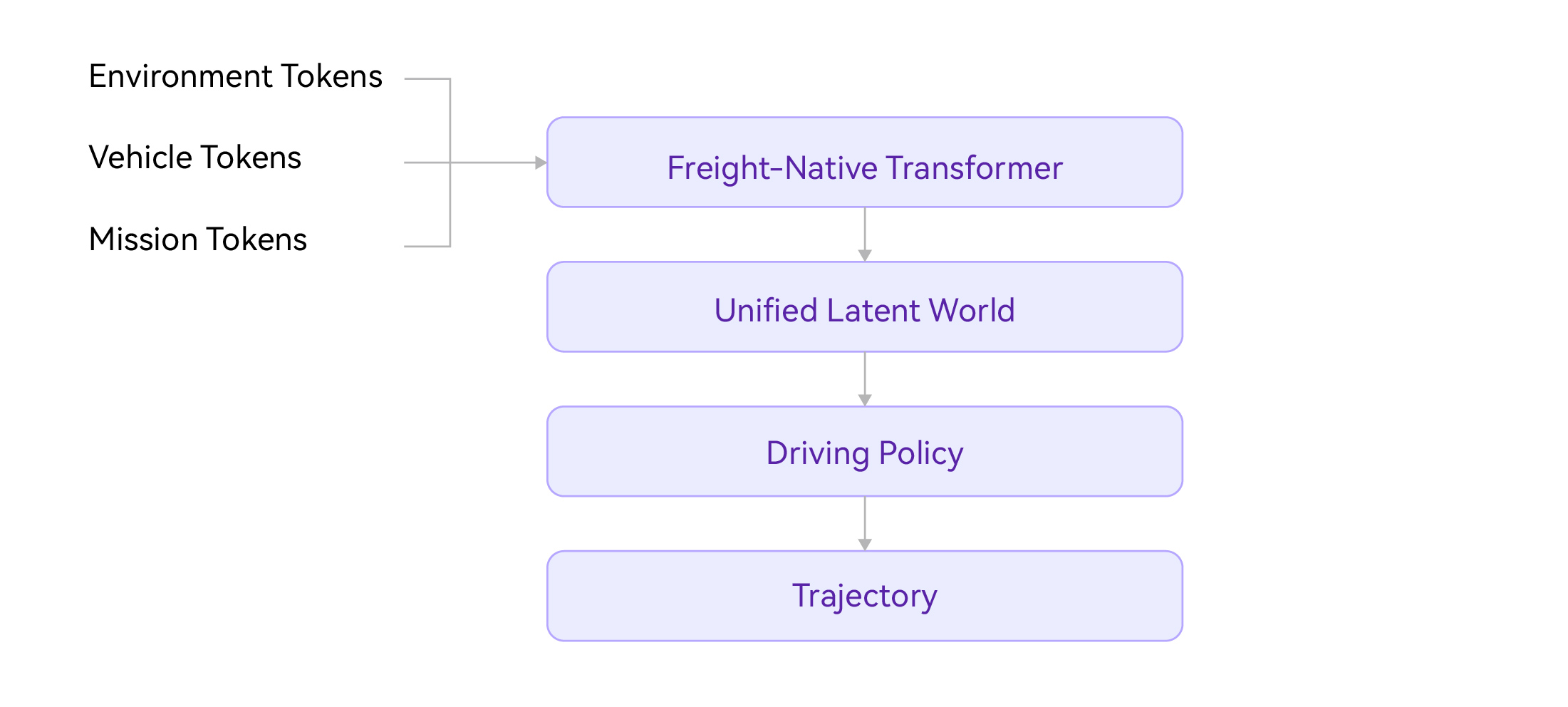
Within the unified architecture of the Freight-Native E2E Model, Environment, Vehicle, and Mission are not arranged in a hierarchical relationship. Instead, they establish deep interactions through Self-Attention and Cross-Attention within a unified Transformer.
The Environment Encoder constructs a representation of the external world, the Vehicle Encoder establishes a representation of the vehicle’s internal state and dynamics, and the Mission Encoder encodes the logistics mission.
Because a commercial vehicle’s own actions can significantly affect surrounding traffic participants, the tokens generated by the Environment and Vehicle encoders need to engage in deep information exchange through Cross-Attention.
The Mission Token helps the model determine which information in the current Environment is most important for the mission. Through Cross-Attention, it guides how the Vehicle representation attends to the Environment over extended time horizons, thereby consistently influencing driving behavior over time. Without the guidance of the Mission Token, the Vehicle representation may focus primarily on the immediate rationality of driving behavior over the next few seconds.
The Freight-Native E2E Model can be unified under the following architecture:
06 | Safety Design of the Freight-Native E2E Model
For commercial vehicles, safety must always be the highest priority of the entire system. The value of end-to-end models lies not only in being “more intelligent,” but also in establishing a comprehensive safety architecture spanning training, model design, and validation. Safety must not be an externally imposed constraint added onto the system; it must become an intrinsic capability throughout the model lifecycle.
Training Safety: Making Safety an Intrinsic Model Capability
Within the Environment Encoder, we build a multiscale 3D scene representation tailored to commercial vehicles. At long distances, semantic spatiotemporal representations establish long-horizon traffic understanding. In the near field, high-resolution 3D Occupancy representations establish precise spatial safety boundaries.
At the Policy stage, the model must learn not only “how an expert driver should drive,” but also “which behaviors are risky” and “how to recover when the vehicle deviates from its ideal state.”
For commercial vehicles, “behaving like an expert” does not necessarily mean “being safe.” Two trajectories may have almost identical L2 distances from an expert trajectory, yet one may pass safely while the other carries a risk of collision or sideswipe.
Therefore, model training must evolve beyond pure expert imitation to incorporate hard-example learning, perturbation learning, and self-recovery learning. Training objectives must incorporate collision risk, Time-to-Collision (TTC), safety boundaries, vehicle stability, braking intensity, and the vehicle-dynamics constraints specific to commercial vehicles.
The goal of training is to progressively transform safety from a capability that depends solely on external rules into an intrinsic capability learned by the model from massive amounts of real-world commercial-vehicle data.
Design Safety: Keeping Intelligence Within Safe Operating Boundaries
End-to-end does not mean eliminating independent safety constraints. The end-to-end model is responsible for understanding complex environments and generating driving policies. After the model produces an optimal trajectory, the system must still independently evaluate it in terms of collision risk, road boundaries, vehicle dynamics, and vehicle stability. When necessary, the safety module can constrain or even override the model’s output.
The end-to-end model determines which strategy best aligns with operational objectives within the safe feasible space, while the safety module determines which behaviors are never acceptable. This allows intelligence and safety to coexist within the Freight-Native E2E system.
Validation Safety: Moving from Prediction Accuracy to Closed-Loop Behavioral Validation
Production deployment of autonomous commercial vehicles requires rigorous safety validation. For end-to-end models, genuine safety validation must take place in a closed-loop environment, where the model continuously encounters new states resulting from its own decisions. The ultimate objective is to evaluate whether the entire driving process remains safe and stable and whether the logistics mission is successfully completed.
This requires continuously collecting risk scenarios from real-world fleets and conducting regression testing and safety validation through sensor-level closed-loop simulation, ultimately establishing a continuously evolving data loop. Every model upgrade is therefore not merely an update to network parameters, but an upgrade in driving capabilities that has undergone comprehensive safety validation.
07 | From General-Purpose E2E to Freight-Native Intelligence
For commercial vehicles, end-to-end autonomous driving is a starting point, not the destination. Truly intelligent driving for freight transportation should not be merely a model that “knows how to drive.” It must understand what is happening in the current environment, what its own vehicle is capable of doing, and what the current transportation mission actually aims to accomplish.
We therefore believe that the defining feature of next-generation end-to-end autonomous driving for commercial vehicles is not simply a larger model, but the establishment of Freight-Native Intelligence that is genuinely designed around logistics operations.
From Environment-aware, to Vehicle-aware, and then to Mission-aware, commercial-vehicle autonomous driving is evolving from “driving according to the road” toward “driving around the logistics mission.”
Today, we can progressively unify world understanding, vehicle capabilities, and mission-driven decision-making while maintaining engineering controllability and safety verifiability. In the future, as data scale, training systems, and safety-validation capabilities continue to mature, Environment, Vehicle, and Mission will become further integrated into a truly unified Freight-Native E2E Model.
At that point, the vehicle will no longer be merely an automated machine executing predefined driving logic. It will become an intelligent transportation system capable of understanding its environment, understanding itself, understanding its mission, and continuously making safe and efficient decisions in pursuit of logistics objective.