Freight Physical AI: Building Intelligence for the Real World of Logistics
2026-11-10
A fully loaded 49-ton truck traverses a rain-slicked highway at night. A general-purpose AI can detect the taillights ahead and read the lane markings. But it cannot grasp what 49 tons, liquid payload, wet pavement means for stopping distance and rollover risk. An empty truck and a fully loaded one should be two different vehicles in the eyes of AI - but general-purpose autonomous driving models do not understand this. This is why freight needs its own AI.
1. From Autonomous Driving to Freight Physical AI
Our mission is to make logistics graceful.
For the past eight years, we have focused on one of the most challenging problems in logistics: building autonomous driving technology for commercial vehicles. Working with major OEMs, we have deployed autonomous driving technology across more than 10,000 commercial trucks in China, accumulating more than 1.2 billion kilometers of autonomous driving mileage. Along the way, we have developed deep expertise across perception, prediction, planning, vehicle systems, safety, data infrastructure, and large-scale real-world deployment.
This experience has taught us that making freight truly intelligent requires going beyond general-purpose autonomous driving, which has largely been shaped around the needs and characteristics of passenger vehicles. Freight vehicles operate under fundamentally different physical and operational conditions, requiring intelligence that is built specifically for the realities of freight.
First, intelligence must be freight-native. Commercial vehicles are fundamentally different from passenger cars. Their size, mass, payload, braking distance, maneuverability, and vehicle dynamics directly determine what they can safely perceive and do. A maneuver that is feasible for a passenger car may be physically impossible for a fully loaded heavy-duty truck. The vehicle itself therefore needs to be part of the intelligence.
Second, intelligence must learn from the real-world scenarios of freight. Freight vehicles operate across an enormous range of environments, weather conditions, road types, traffic interactions, and operating situations—from highways and mountain roads to delivery locations and loading areas, across challenging conditions such as rain, fog, heat, and ice. Understanding these situations is essential to building AI that can operate reliably in the real world.
Third, intelligence must extend across the vehicle and the logistics operation. A freight vehicle does not operate in isolation. It requires coordinated intelligence between the vehicle and the cloud—combining real-time vehicle intelligence with cloud-based understanding of the broader operation to continuously monitor and optimize safety, energy efficiency, and operational performance. The ultimate objective is not simply to move one vehicle from A to B, but to make the entire freight operation safer, more efficient, and more resilient.
These three requirements define a fundamentally different intelligence challenge—one that goes beyond autonomous driving. We call the technology built to address it Freight Physical AI, the evolution of autonomous driving for the physical realities and broader needs of freight.
2. Our Approach to Building Freight Physical AI
Freight Physical AI is our approach to building AI around the realities of freight—not adapting general-purpose AI to trucks, but designing intelligence around the vehicle, the scenarios it encounters, and the operations it serves. We see three interconnected capabilities forming a continuous cycle: Freight-Native Intelligence enables vehicles to perceive and act within their physical and operational context; Scenario Intelligence understands real-world freight situations; and Operational Intelligence extends intelligence beyond the vehicle, using broader operational context to identify risks, optimize operations, and coordinate actions across the freight system.
2.1 Freight-Native Intelligence
We are building a new generation of freight-native models, designed and trained around the physical characteristics and operating scenarios of commercial vehicles. Our approach combines two closely connected capabilities: an end-to-end model that enables the vehicle to understand and act, and a Freight World Model that represents and simulates the world around it.
2.1.1 Freight-Native End-to-End Models
Over the past eight years, we have built deep expertise in on-vehicle AI, from multi-sensor BEV and occupancy networks to deep learning planners. Through this experience, we have learned that better performance comes from incorporating key vehicle characteristics and operational context directly into neural network design and training. Building on this foundation, we design our freight-native end-to-end model around two key inputs: the vehicle and its operational context:
Policy = f(Vehicle, Operational Context)
Vehicle. The model explicitly incorporates vehicle characteristics such as the size and dimensions of a heavy-duty truck, enabling it to better understand its spatial footprint and surrounding clearance. This helps the truck make safer decisions when navigating narrow roads, passing other large vehicles, or maneuvering in constrained environments. Other characteristics, including braking capability, tire slip ratio, and vehicle dynamics, further ensure the model's driving policy reflects the physical capabilities of the vehicle.
Operational Context. Driving decisions are shaped not only by the vehicle, but also by the operating environment and what the vehicle is trying to accomplish. For environment understanding, we introduce a unified freight-centric latent world representation that combines semantic context, 3D geometry, and dynamic agents across spatial ranges. It reasons about road topology and potential interactions at long range, while using fine-grained geometry and agent interactions in the near field to assess risk and anticipate how the environment may evolve. This structured representation provides a foundation for downstream planning and decision-making.
The same vehicle in a similar traffic situation may require very different actions depending on its mission—for example, cruising on a highway, approaching a delivery location, searching for a parking or loading position, or waiting in a queue. By incorporating the vehicle’s mission directly into the model, it can generate trajectories that account for both the immediate environment and the specific requirements of the freight operation.
The training objective is also designed around the physical realities of freight. Beyond learning from observed driving behavior, the loss function explicitly incorporates freight-specific physical constraints and safety requirements. For example, unsafe clearance or infeasible trajectories under specific road conditions can be penalized during training, helping the model learn not only what is observed in driving data, but also what is physically feasible and safe for the vehicle.
Together, freight-aware inputs and training enable a more capable and adaptive driving policy for real-world freight. The model can dynamically adapt to different vehicle configurations, freight missions, route constraints, adverse weather, and complex interactions with other road users - bringing end-to-end intelligence closer to the realities of freight operations.
2.1.2 Freight World Model
An end-to-end model determines how the vehicle perceives and acts. Achieving true L4 autonomy, however, requires training and evaluating that intelligence across a vast range of scenarios. Real-world testing alone cannot provide sufficient coverage within a practical timeframe, while many safety-critical scenarios cannot be safely reproduced on public roads. Our Freight World Model addresses this challenge by creating a high-fidelity virtual world where realistic environments and interactions with the ego vehicle can be reconstructed and reproduced at scale.
Rather than relying on a single generative model to predict every future state, our Freight World Model is a composable freight simulation and reconstruction system designed for both realism and controllability. It integrates asset extraction, sensor rendering, and intelligent agents to recreate the physical environment and its interactions with the ego vehicle, enabling our driving policies to be trained, tested, and continuously improved across a broad range of freight scenarios.
Our asset extraction technology reconstructs dynamic objects and static surroundings from real-world driving data, capturing the physical elements of the environment. Our sensor rendering technology then combines these assets into realistic environments and applies a range of techniques to improve the fidelity of the generated sensor data.
The design of our Intelligent agents model how traffic participants interact with each other and with commercial vehicles. This is particularly important for freight, where the presence of a large commercial vehicle can significantly influence the behavior of other road users. Some drivers may maintain greater distances from a truck, while others may make aggressive maneuvers to pass or avoid it. These behaviors depend on the physical characteristics of the truck, the surrounding environment, and the behavior of other agents.
Our Freight World Model and end-to-end model form a closed learning loop, combining real-world data with scalable simulation and reinforcement learning to continuously improve driving policies. This moves freight AI beyond general-purpose driving models toward intelligence natively designed around vehicle physics, freight scenarios, and logistics missions.
2.2. Scenario Intelligence
Real-world data is essential to Physical AI. Accumulating more driving data provides broader coverage of real-world conditions and helps improve autonomous driving performance. But as data scales, the critical challenge becomes understanding and managing the scenarios within it. For us, a scenario is a human-understandable semantic representation of a real-world situation—capturing the objects, behaviors, interactions, operating conditions, and risks that matter. Scenario Intelligence transforms raw sensor data into this structured understanding of the situations autonomous vehicles must handle.
To build this intelligence at scale, we developed a scenario labeling system with thousands of semantic labels specifically designed for freight operations. It represents scenarios at different levels of abstraction, from atomic events to compound situations, with operations for combining, aggregating, and approximating them. Supporting this semantic framework is our Data Factory, a large-scale data processing system comprising thousands of pipelines and workflows, many of them automated. Its four-layer data processing stack continuously extracts, organizes, and enriches meaningful scenarios from massive volumes of operational data.
The result is our Real-world Operation Scenario Library (ROSL)—a searchable and continuously growing representation of the real world, now containing more than 200,000 unique, high-value scenarios. Rather than simply accumulating driving miles, ROSL captures the diversity, distribution, interactions, and risks that define real freight operations, giving us a structured view of the world in which our vehicles must perform.
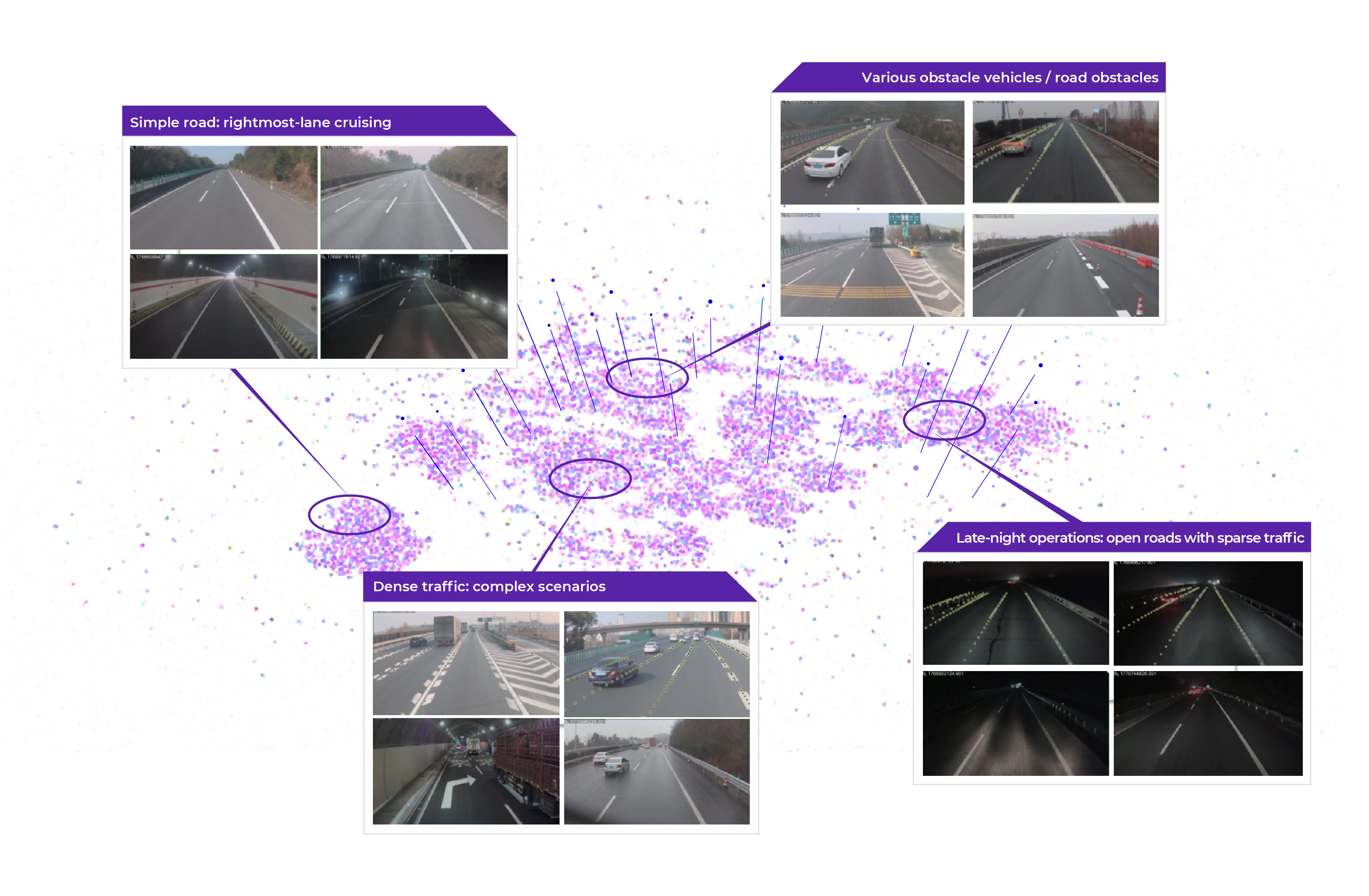
Scenario distribution visualization based on a randomized scenario set.
Each point represents a scenario moment, revealing clear hotspot regions in the distribution.
ROSL turns this understanding into an engineering and product asset. We use it to systematically select scenarios for training, evaluation, regression testing, and model improvement, while also using the real-world distribution and operational impact of these scenarios to prioritize product capabilities, define quality requirements, and establish quality-control strategies. This ensures product and engineering decisions reflect what matters in actual freight operations—not just in model metrics.
ROSL also helps continuously improve our Freight World Model by grounding it in scenarios observed in real freight operations. This allows us to identify gaps between the modeled and physical worlds and improve the model’s ability to represent and simulate real-world freight operations. This creates a powerful data flywheel for the transition from L2+ deployment to L4 autonomy: real-world L2+ operations continuously expand our scenario understanding, which in turn makes the world model more representative and enables more effective simulation, training, and evaluation for increasingly capable autonomous systems.
This is why we see L2+ commercialization not as a detour from L4, but as a direct path to L4. Every mile our L2+ trucks operate—with real freight, real routes, real weather, and real operational demands—generates valuable scenarios that can improve our models, validate performance, and expose the long tail of real-world challenges. As deployment scales, this feedback loop continuously strengthens both our product and our world model, accelerating the path toward L4 autonomy.
2.3. Operational Intelligence
As autonomous vehicles progress from L2+ toward L4, intelligence must extend beyond the vehicle to address the broader challenges of freight operations. The on-vehicle algorithms needs to make millisecond-level decisions in real time, processing dense, high-frequency sensor data to respond to its immediate surroundings. Many operational decisions, however, require a broader view of the vehicle, its environment, and the logistics network over much longer time horizons, typically at the second level or above.
To address this, we developed an Operational Brain - a cloud-based intelligence layer that complements the on-vehicle Freight-Native models. It processes data from individual vehicles and across the fleet to identify operational risks, optimize vehicle operations, and coordinate with the broader freight system through Operational Monitor and Operational Optimizer.
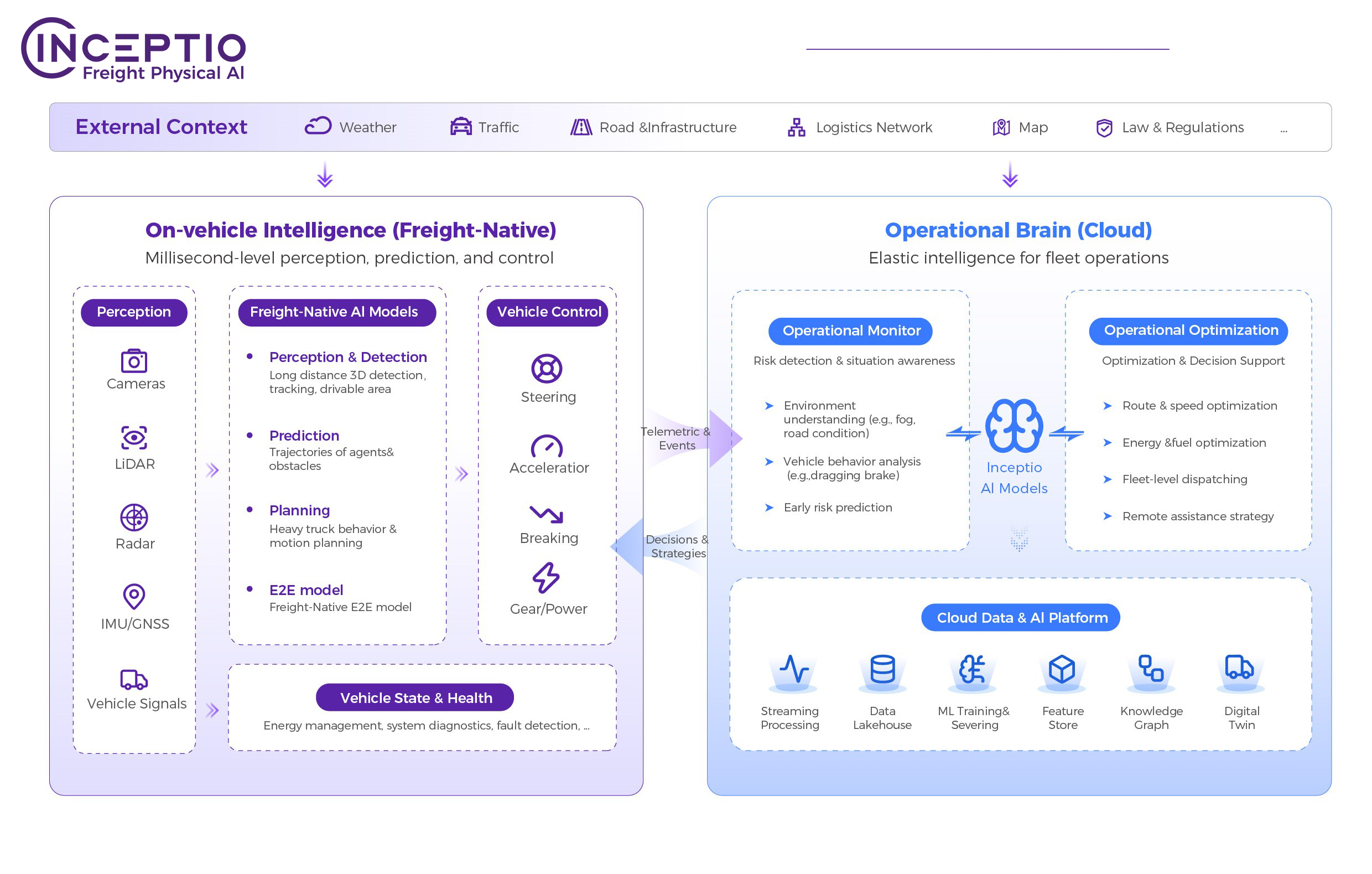
How Inceptio Operational Brain works based on the On-vehicle Freight-Native models
Operational Monitor uses specialized machine learning models and data-driven algorithms to identify challenging operating conditions and abnormal vehicle behavior that may be difficult to recognize from the vehicle alone. For example, specialized neural networks can detect low-visibility conditions such as dense fog, while data-driven predictive models can identify early signs of a dragging brake from vehicle behavior and telemetry. By combining vehicle behavior with broader operational context, operational monitoring algorithms provides an additional layer of intelligence to detect and address high-risk situations before they escalate.
Operational Optimizer combines optimization algorithms, energy modeling, and remote-control technologies to optimize vehicle operations and respond to unexpected situations. It performs coarse-grained route and speed planning using models of auxiliary energy consumption, regenerative energy utilization, and fuel consumption. When unexpected situations occur, it enables remote intervention to help recover stranded vehicles and coordinates vehicle-level actions with logistics scheduling systems.
Together, Operational Monitor and Operational Optimizer form a cloud-based intelligence layer that coordinates with the on-vehicle Freight-Native Model. While the vehicle provides real-time intelligence and control, the Operational Brain applies fleet-level algorithms to optimize and coordinate the broader operation. This enables L4 vehicles to operate as intelligent participants in the freight system - making logistics safer and more efficient.
3. From Autonomous Vehicles to Freight Robotics Network
As autonomous trucks become more capable and connected, individual vehicles can evolve into coordinated fleets that share intelligence, adapt to changing conditions, and work directly with logistics systems. This creates a path from vehicle-level autonomy to a connected freight robotics network—where intelligent vehicles, infrastructure, data, and logistics operations work together across the physical world.
We believe this network can become fundamental infrastructure for the future of logistics, moving goods more safely, efficiently, and continuously. Freight Physical AI is the technology foundation for this future, providing the intelligence that enables freight robots to understand and operate within the physical and operational complexity of logistics, learn from real-world experience, and continuously improve as part of a connected system.
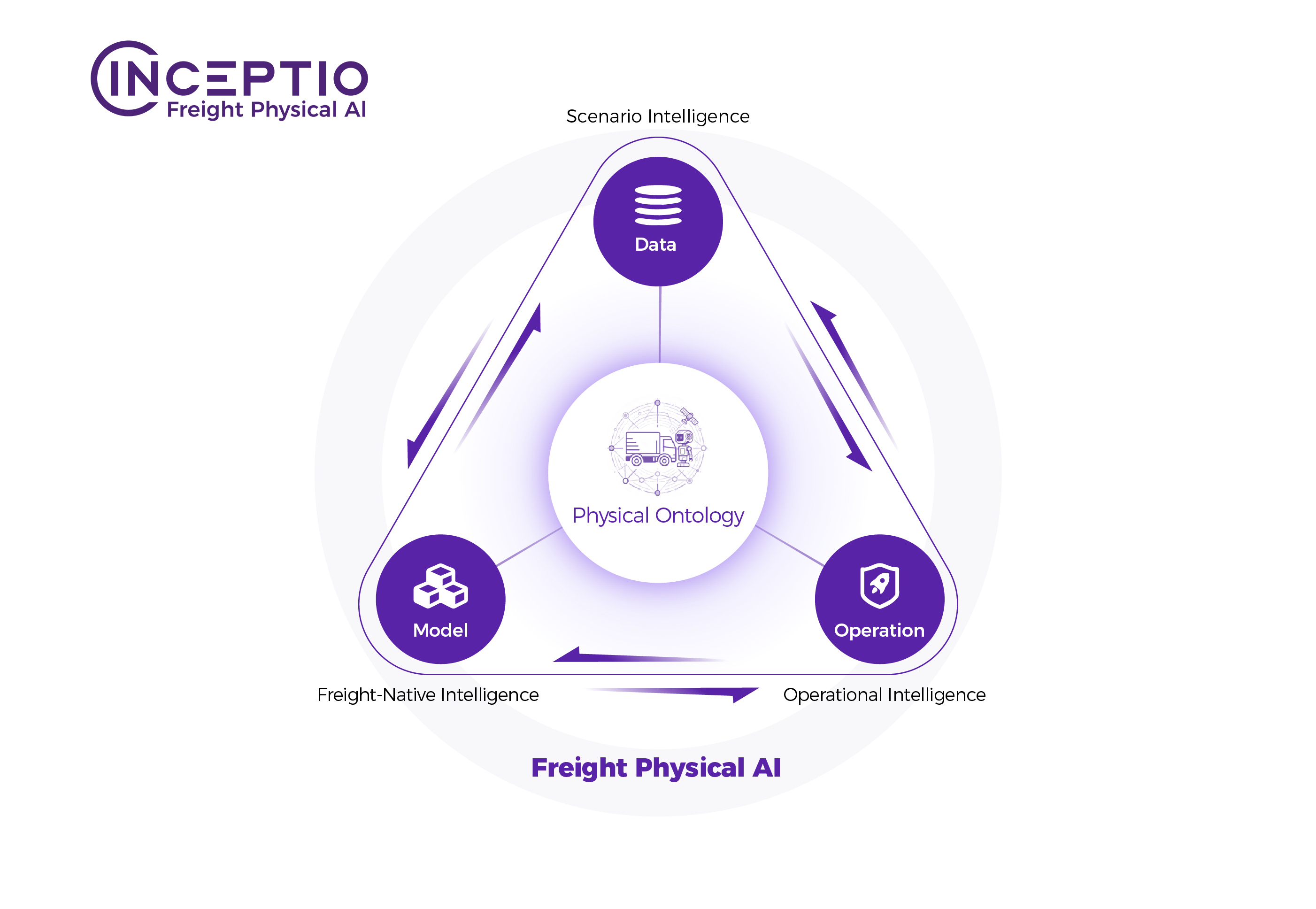
Our journey toward this vision began with heavy-duty trucks—the most physically challenging freight vehicle class. A 49-ton truck brings fundamental physical challenges, including longer braking distances, complex trailer dynamics, and payload-sensitive control. Solving these challenges gave us firsthand experience with the unique demands of freight autonomy.
As we extend our Freight Robotics Network to light-duty trucks and last-mile delivery, this experience gives us a strategic advantage. Our Freight Physical AI is built from the realities of freight vehicles and logistics operations, rather than adapting general-purpose autonomy to freight, which requires addressing fundamentally different physical and operational demands. Over eight years, this work has given us a deep and evolving understanding of freight—and a clear view of what it takes to build the intelligence the industry needs. We will continue to advance Freight Physical AI across the freight ecosystem, working toward logistics that are safer, more efficient, and ultimately, graceful.