TV Tokyo Highlights Inceptio Technology’s Commercial Autonomous Trucking Deployment and 1-Billion-Kilometer Milestone
2026-09-15
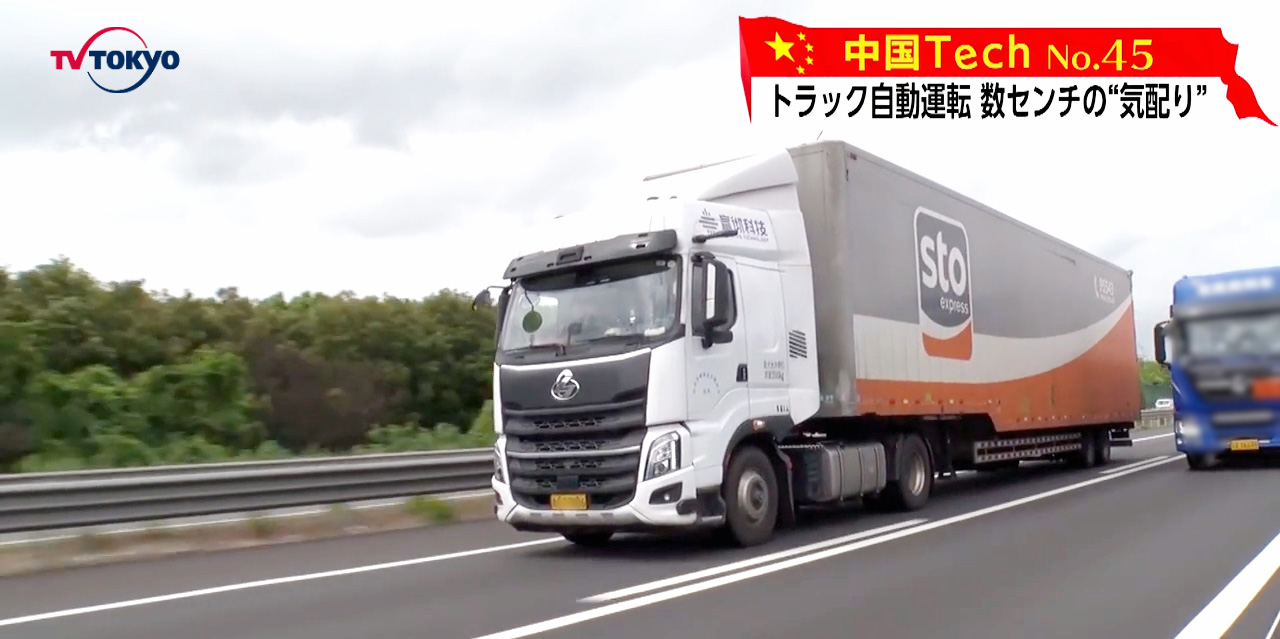
Inceptio Technology (“Inceptio” or the “Company”), an industry-leading developer of autonomous driving technologies for heavy-duty trucks, was featured in an in-depth report on autonomous trucking aired as part of the “China Tech” segment on TV Tokyo’s NEWS MORNING SATELLITE on September 8, 2026.
The report, which ran for more than 10 minutes, examined the development and commercial deployment of autonomous trucking in China, highlighting Inceptio’s large-scale commercial operations, safety-oriented technology, accumulation of real-world operational data, and continued development toward L4 autonomous trucking.
Click the official website to watch the full report. https://txbiz.tv-tokyo.co.jp/nms/special/post_348282
Bringing Autonomous Driving into Real-World Freight Operations
China’s large-scale freight transportation network provides significant scope for the commercial deployment of autonomous trucking. The report followed a heavy-duty truck driver on an approximately 800-kilometer journey from Shandong to Shanghai, illustrating the demands of long-haul freight transportation.
The driver explained that such a journey previously required two drivers working in shifts. The autonomous driving system has enabled him to complete the same route as the sole driver, significantly reducing the workload associated with long-haul transportation. He also reported that the system now handles more than 90% of his route.
Under Inceptio’s autonomous driving system, the vehicle can control its speed and change lanes while the driver remains responsible for supervision. The report also demonstrated how the system responds to specific scenarios encountered in heavy-duty freight transportation. For example, when a large vehicle travels alongside the truck, the system can subtly adjust the truck’s position within its lane to create more clearance without crossing the lane marking, supporting safer and more confident long-haul driving.
Technology Designed for Safety and Real-World Freight Scenarios
TV Tokyo also visited Inceptio’s Shanghai office to examine the Company’s autonomous driving technology and safety capabilities.
Inceptio’s autonomous driving system integrates LiDAR, cameras, and radar to perceive and respond to complex road environments. The system is designed to support high-precision vehicle control, with control precision of approximately 7 centimeters in relevant scenarios.
The report also showcased Inceptio’s driver monitoring system, which uses AI to monitor driver attention and identify potential distraction or fatigue. For example, if the system detects that a driver has been looking at a mobile phone for around 10 seconds, it can trigger a strong seat vibration and an audible warning to prompt the driver to refocus.
These capabilities reflect Inceptio’s focus on developing autonomous driving technology for the specific requirements of commercial freight transportation, in which vehicle size, braking distance, cargo weight, and changing road conditions present distinct challenges for autonomous driving.
One Billion Kilometers of Commercial Autonomous Driving
A key focus of the report was Inceptio’s scale of commercial deployment.
In August 2026, Inceptio surpassed 1 billion kilometers of cumulative commercial autonomous driving mileage. The Company currently remotely manages approximately 7,000 autonomous trucks operating across China.
The milestone represents not only the scale of Inceptio’s commercial operations but also the depth and diversity of real-world operational data generated through daily freight transportation. This data enables Inceptio to identify, reproduce, validate, and resolve increasingly complex scenarios in commercial freight operations, supporting continuous improvement and validation of its autonomous driving systems.
By combining large-scale commercial deployment with real-world data accumulation, Inceptio is building a foundation for the continued development of autonomous trucking and its broader vision for Freight Physical AI: intelligent systems designed for the physical environments, operating conditions, and logistics requirements of commercial freight transportation.
From L2+ Commercial Deployment to L4 Autonomous Trucking
The report also examined Inceptio’s roadmap toward L4 autonomous trucking.
Inceptio estimates that approximately 8 billion kilometers of real-world data will be needed to support the development and validation of L4 autonomous driving technology. The Company expects to accumulate this volume of data by 2028 and is targeting commercial operations with no driver in the cab around the same timeframe.
Inceptio’s approach combines large-scale L2+ commercial deployment with the continued development and validation of L4 autonomous driving technology. Its extensive commercial operations generate real-world data across diverse freight scenarios, enabling the Company to advance commercial deployment, data accumulation, scenario validation, and technology development in parallel.
In its analysis of the global autonomous trucking landscape, TV Tokyo contrasted Inceptio’s approach with that of U.S.-based Aurora Innovation, which has focused on validating L4 systems with safety drivers before progressively removing the driver and expanding its operational domain. The comparison highlighted the different approaches companies are pursuing globally to advance L4 autonomous trucking.
Building a Global Foundation for Autonomous Freight
The report also highlighted the international opportunities and challenges surrounding autonomous trucking. Inceptio has begun collaborating with industry players in Japan, Europe, and the Middle East while continuing to explore how to apply and validate its technology in international markets.
As autonomous trucking expands globally, differences in road environments, regulations, data requirements, and operating conditions will require market-specific technology validation and localization. Inceptio’s large-scale commercial deployment and accumulated real-world operational data provide a foundation for continued technology development across diverse freight scenarios.
TV Tokyo also cited the International Energy Agency (IEA), which forecasts that autonomous vehicles could account for up to one-quarter of heavy-duty trucks operating between hubs across the United States, Europe, and China by 2035. The outlook underscores the significant market opportunity for autonomous trucking and its potential to address major challenges facing the global freight transportation industry.
Having accumulated more than 1 billion kilometers of commercial autonomous driving mileage, Inceptio continues to transform real-world commercial experience and data into intelligent capabilities, accelerating the evolution of autonomous trucking toward safer, more efficient, and increasingly intelligent freight transportation.